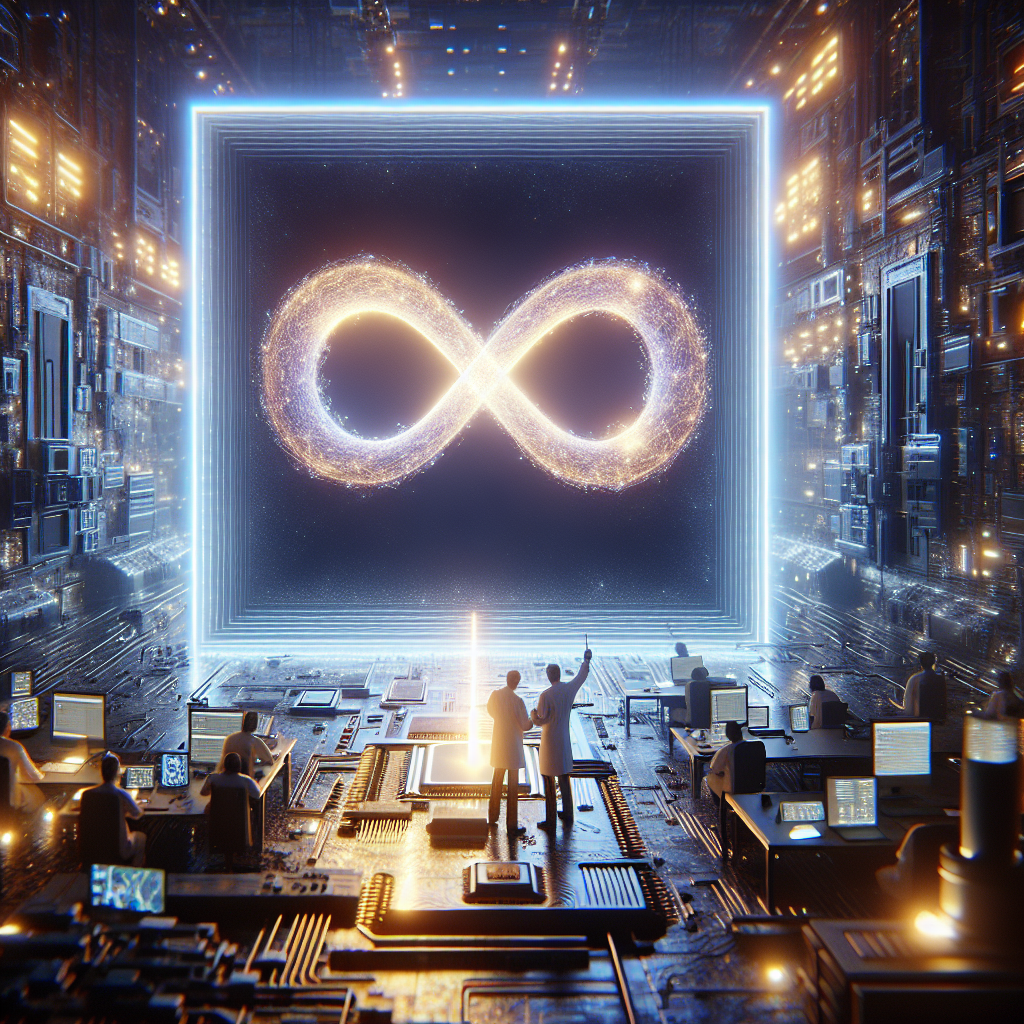
A Groundbreaking Bridge Between Infinity and Computer Science
Can the enigmatic concept of infinity, long considered the domain of pure mathematics, shape the future of computer algorithms? A recent breakthrough has uncovered a surprising connection, offering computer scientists new tools to tackle previously unsolvable computational problems. What could this mean for the way technology interacts with infinite systems — and how might it transform industries relying on computational efficiency?
Understanding Infinity: A Math Problem Rooted in Complexity
Infinity is one of the most mind-bending concepts in mathematics. Far from just a number, it represents an abstract idea: something unbounded, endless, and often paradoxical. Mathematicians have grappled with the intricacies of infinity for centuries through concepts like Cantor’s infinite sets and Hilbert’s Hotel paradox. But why would this abstract notion be relevant to computer science, a field built on the finite logic of 1s and 0s?
To computer scientists, infinity doesn’t manifest as an unreachable number — it emerges in problems involving vast datasets, endless loops, or algorithms that seem to stretch infinitely in complexity. Surprisingly, new research has uncovered that infinity’s math can provide practical insights into tackling these computational challenges, especially around tasks involving optimization and data structures.
The Bridge Between Infinite Sets and Computation
A major finding, recently publicized by a group of researchers, involves applying the study of “large cardinals” (a type of infinity concept) to understand problem-solving models in computer science. Large cardinals give mathematicians tools to categorize different “sizes” or levels of infinity — an idea famously derived from Georg Cantor’s work in the 19th century.
In their research, the team explored how infinite sets relate to the well-known P versus NP problem — a major unsolved question in theoretical computer science that asks whether problems that can be verified in polynomial time (P) can also be solved in polynomial time (NP). Although the direct relationship remains unresolved, tapping into infinite mathematics to approach bounded systems of P versus NP has shown uncanny potential to reevaluate computational limits.
This discovery is more than theoretical; it provides a computational worldview where algorithms can analyze problems through “infinite dimensions” and optimize tasks based on novel mathematical relationships.
From Algorithms to AI: The Practical Implications
Why should this matter to modern technology? Because infinity-based mathematics could offer new approaches to challenges that were once outside the boundaries of computation. Areas like:
- Artificial Intelligence: AI systems frequently deal with near-infinite scenarios, such as generating countless possible chessboard moves or parsing an endless stream of data. By utilizing the peculiar logic of infinite systems, AI could make smarter predictions faster.
- Cybersecurity: Encryption and decryption algorithms often rely on assumptions about mathematical limits. Infinite math may provide fresh perspectives on creating secure cryptographic methods against increasingly sophisticated threats.
- Big Data Analysis: Huge, near-infinite datasets can be analyzed more effectively by applying frameworks inspired by the structure of infinite systems.
These practical implications suggest a new frontier for computer science, offering novel solutions to longstanding limitations in computational speed and complexity.
Infinite Math Meets Real-World Challenges
Although the research is still at an early stage, optimism surrounds the potential real-world applications. Imagine an artificial intelligence algorithm that’s better at approximating solutions by understanding the behavior of infinite possibilities, or cybersecurity solutions that fundamentally rethink the very basis of modern cryptography using insights from infinite structures.
Furthermore, these advances could help address undecidable problems within computational theory. For example, problems requiring decision trees of exponential size could suddenly be reframed using infinite-set approximations. Similarly, complex programming challenges in fields like biology and physics, where vast and intricate data interact, could benefit from these unique methods.
Challenges and Next Steps for Research
Of course, not all aspects of this intersection are straightforward. Theories about infinity in mathematics are often abstract, and bridging them with real-world computation involves interpreting analogies, not direct applications. Significant work remains to provide tangible implementations through code or algorithms.
Nevertheless, the initial crossover is remarkable and has sparked excitement among computer scientists and theorists. Over the next decade, we may see these ideas mature, possibly reinventing the way we approach tasks like algorithmic design, solving optimization problems, or even answering long-standing scientific questions.
Conclusion: Infinite Possibilities in a Finite World
The bridge between the strange yet fascinating mathematics of infinity and the practical world of computer science opens new opportunities in solving some of the world’s toughest technical problems. As researchers delve further into the connections between large cardinals and computational theory, we may unlock algorithms capable of transforming artificial intelligence, cybersecurity, and beyond.
For now, this intriguing development underscores the value of interdisciplinary thinking, where seemingly unrelated fields like infinite mathematics and computer science combine to chart new directions for innovation. If the idea of applying infinite math to real-world technology is new to you, now is the time to dive in and explore this cutting-edge research.
Want to stay ahead of the curve? Check out additional resources on infinity and computer science or explore other breakthroughs in the field of theoretical mathematics.
Don’t miss the chance to be part of this fascinating journey – a future where infinity could define the next evolution of computation.
No responses yet